

This application note offers a detailed overview of how the Potentiostat device is utilized in electrochemical water-splitting studies. This note aims to help researchers understand and effectively utilize the MedPstat 2.O device for their water-splitting experiments. It also focuses on understanding oxidation and reduction processes in alkaline media through Cyclic Voltammetry and Linear Sweep Voltammetry techniques.
What you will learn in this Application Note:
- Why is Electrochemical water-splitting widely used in energy applications?
- What are the two key reactions involved in electrochemical water splitting?
- How is the water splitting reaction conducted in alkaline media?
- How can the onset potential be determined using Linear Sweep Voltammetry (LSV)?
- How slow scan rates help the Electrochemical reaction kinetics?
- What are the advantages of using LSV over other electrochemical techniques for analyzing water-splitting reactions?
Introduction:
The rapid rise in global energy demand, combined with the ongoing depletion of fossil fuels, highlights the urgent need for sustainable and renewable energy sources. Hydrogen has emerged as a leading alternative fuel due to its high energy density, clean combustion, and minimal environmental impact. Among various hydrogen production methods, electrochemical water splitting stands out as an efficient and eco-friendly approach. This process relies on two fundamental reactions: the Oxygen Evolution Reaction (OER) and the Hydrogen Evolution Reaction (HER), both of which play a crucial role in advancing green hydrogen technologies.
This provides a realistic approach to manufacture high-purity hydrogen. A significant issue in this process is dealing with the sluggish kinetics of both HER and OER, with OER being particularly difficult due to its complex multistep proton-coupled electron transfer process, also known as a four-electron process. This application note will focus on water-splitting in alkaline media, a method that is effective in overcoming the challenges associated with the OER.
Principle:
Water electrolysis operates on the principle of using electrical energy to split water into its fundamental gases, oxygen and hydrogen. In this process, the Oxygen Evolution Reaction (OER) at the anode generates oxygen gas, while the Hydrogen Evolution Reaction (HER) at the cathode produces hydrogen gas. The overall reactions for water electrolysis are:
H2O (l) → H2 (g) + ½ O2 (g) [∆G° = +237.2KJ mol-1, ∆E° = 1.23V vs RHE]
Half-Reactions of Water Splitting in Alkaline Medium with Corresponding Thermodynamic Potentials (vs. SHE)
Anode ∶ 2OH− → H2O + ½ O2 (g) + 2e− (E° = +0.40 V at pH 14)
Cathode ∶ 2H2O + 2e− → H2 (g) + 2OH− (E° = -0.83 V at pH 14)
Net reaction ∶ H2O(l) → H2 (g) + ½ O2 (g)
Experimental Section:
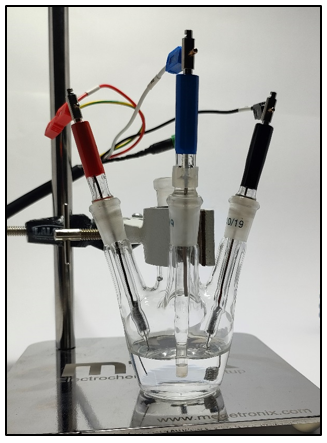
A 30 mL stock solution of 1M potassium hydroxide (KOH) electrolyte was prepared by dissolving high-purity KOH pellets in deionized water to ensure optimal conductivity and experimental accuracy. Electrochemical measurements were performed at room temperature using a standard three-compartment electrochemical cell, a widely adopted setup for controlled and reproducible analysis. The experiments were conducted with the MedPstat 2.0, a portable and compact potentiostat designed for precise electrochemical testing. The device interfaces seamlessly with MedEplot software, which is compatible with both Windows and macOS platforms, enabling efficient data acquisition, visualization, and analysis for advanced electrochemical research.
The working electrode was a 10 mm Platinum wire (MTX Labs, India), embedded in borosilicate glass. A large-area Platinum coil (MTX Labs, India) served as the counter electrode, while the reference electrode was an Ag/AgCl RE (3M KCl, 0.209 V vs SHE).
Before each electrochemical measurement, the platinum cylinder and platinum foil electrodes were thoroughly cleaned to ensure high surface purity and experimental reliability. The electrodes were treated with ethanol in an ultrasonic cleaner to remove surface contaminants, followed by rinsing with high-purity deionized water. This cleaning process was repeated multiple times using both ethanol and deionized water in the ultrasonic cleaner to achieve a contamination-free electrode surface, which is critical for accurate and reproducible electrochemical analysis.
Parameters:
Result and Discussions:
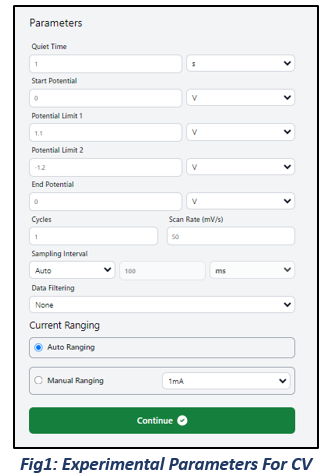
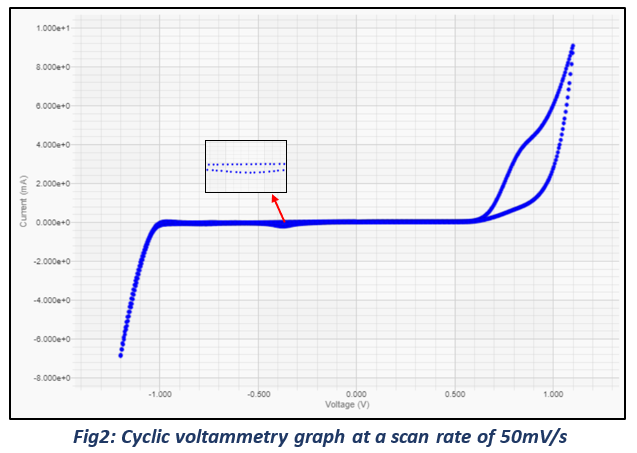
Cyclic voltammetry (CV) was conducted over a potential window of -1.2 V to +1.1 V at a scan rate of 50 mV/s, using 1M KOH as the electrolyte. During the anodic sweep, two distinct oxidation peaks were observed. The first oxidation peak, occurring at approximately 0.64V (vs. Ag/AgCl), is attributed to the oxidation of platinum (Pt), as evidenced by the absence of oxygen bubble formation at this potential. The corresponding current response was measured at 0.04 mA. A sharp increase in current was noted at around 0.73 V, indicating the oxygen evolution at the working electrode (WE).
As the upper potential limit of +1.1 V was reached, the scan direction was reversed, transitioning into the cathodic sweep. A reduction feature emerged at approximately -0.37 V (vs. Ag/AgCl), corresponding to the reduction of Pt, with a current response of -0.23 mA. This reduction event is further detailed in a magnified view, providing additional insight into the Pt reduction mechanism. Additionally, a reduction peak near -1.0 V was observed, attributed to the reduction process of KOH. It provides a comprehensive illustration of the redox processes, highlighting the oxidation of Pt at the anode, which leads to oxygen evolution, and the reduction at the cathode, resulting in hydrogen evolution.
Determination of onset Potential using LSV:
To accurately determine the onset potential, Linear Sweep Voltammetry (LSV) was performed for both oxidation and reduction processes. For the oxidation, the potential was scanned from 0 to 1.1 V, while for the reduction, the range was set from 0 to -1.1 V. Although Cyclic Voltammetry (CV) can also be employed for this purpose, LSV is generally considered more precise for onset potential determination. Therefore, in this study, LSV was exclusively utilized. Consequently, LSV was conducted at a scan rate of 2 mV/s to achieve optimal conditions for precise onset potential detection. At higher scan rates, the characteristic oxidation and reduction peaks of platinum became indistinct, as previously demonstrated in the CV data. To address this issue, a lower scan rate was selected, improving the resolution of key electrochemical features. This adjustment not only enhances data accuracy but also allows the system to properly equilibrate, leading to a more defined observation of both oxidation and reduction peaks. Furthermore, a reduced scan rate minimizes the capacitive current, thereby enhancing the peak separation and providing a more clear interpretation of the electrochemical kinetics.
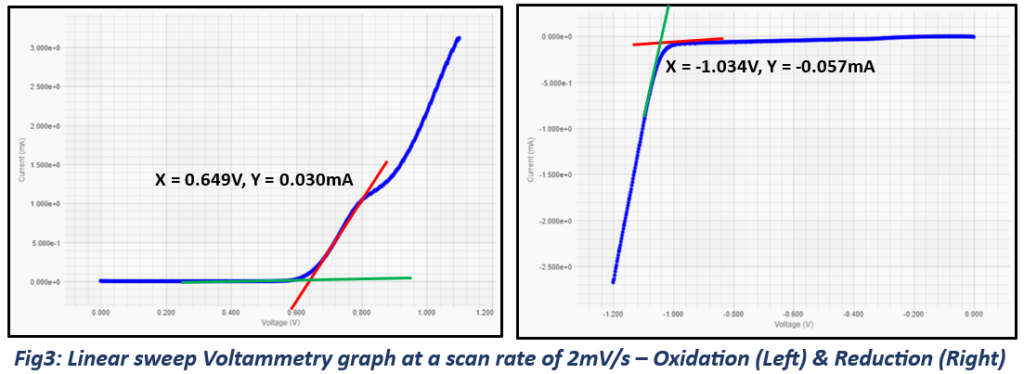
In the resulting graph Fig 3, draw two perpendicular lines at the point where the potential begins to rise, intersecting at the midpoint of the curve (hump). The onset potential for oxidation is 0.649 V (vs. Ag/AgCl) at a current of 0.030 mA, while the onset potential for reduction is -1.034 V (vs. Ag/AgCl) at a current of -0.057 mA.
Conclusion:
This application note highlights the capability of performing cyclic voltammetry (CV) and linear sweep voltammetry (LSV) for electrochemical water-splitting experiments in a 1M potassium hydroxide (KOH) alkaline medium using the MedPstat potentiostat. The study successfully analyzes potential versus current behavior to identify key oxidation and reduction reactions, providing deeper insights into the water-splitting mechanism. Additionally, the evaluation of onset potentials for the Hydrogen Evolution Reaction (HER) and Oxygen Evolution Reaction (OER) enables a better understanding of catalytic activity and efficiency in alkaline electrochemical systems.