Gas-Tight Electrochemical Cell with PTFE Lid
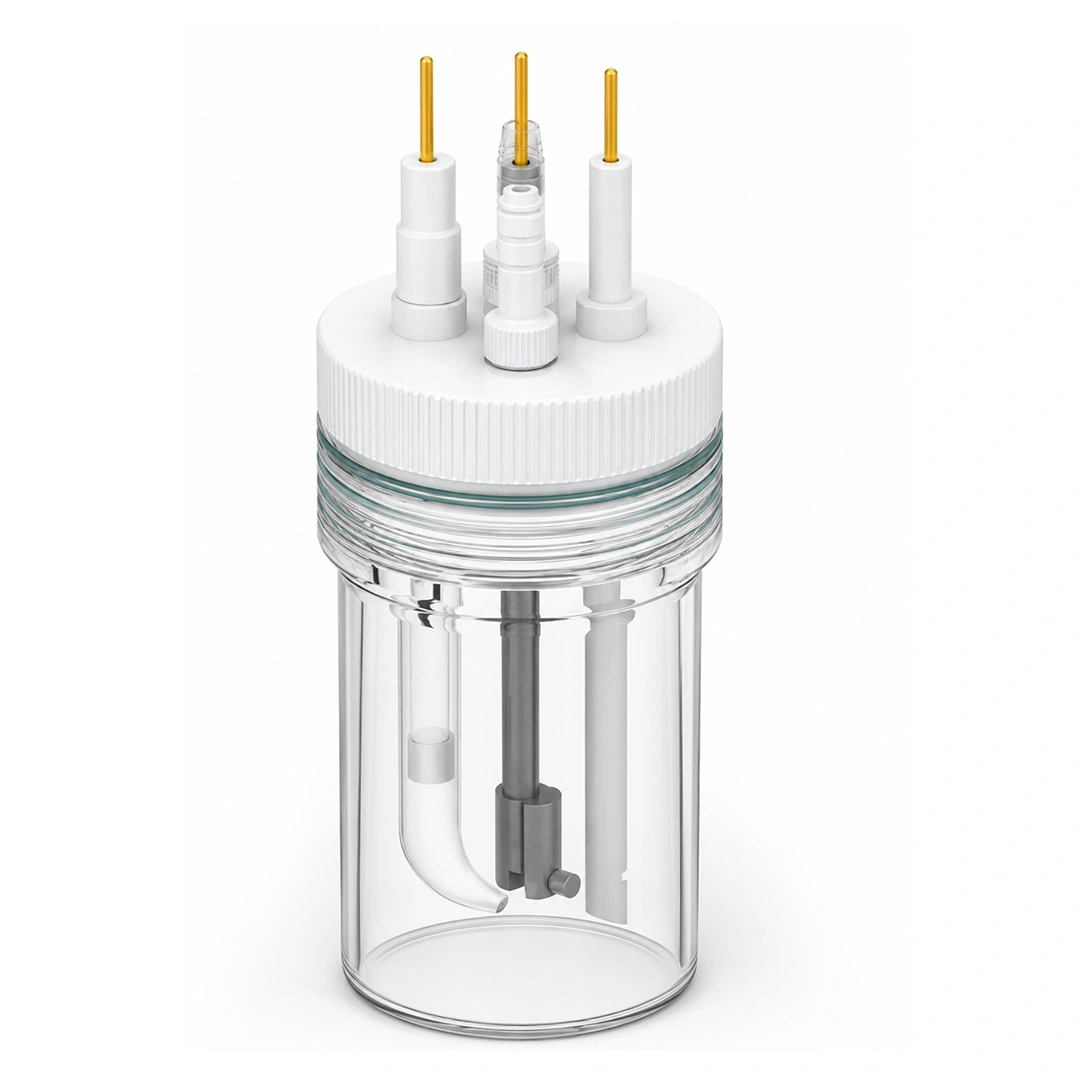
The Gas-Tight Electrochemical Cell is a versatile and highly reliable solution designed for advanced electrochemical experiments requiring controlled atmospheres, stable measurements, and chemical resistance. Constructed from high-quality glass and fitted with a precision-machined PTFE lid, the cell provides excellent sealing performance, making it suitable for a wide range of applications including cyclic voltammetry, electrochemical impedance spectroscopy (EIS), chronoamperometry, corrosion studies, electrocatalysis, photoelectrochemistry, battery research, and sensor development.
The cell utilizes a threaded sealing mechanism with chemically resistant O-rings to achieve a leak-free environment between the glass vessel and PTFE cover. Electrode ports are individually sealed using compression fittings, ensuring secure electrode placement while maintaining an airtight system. This design minimizes contamination from atmospheric oxygen and moisture, enabling highly reproducible measurements.
To support experiments involving inert or reactive gas environments, the cell is equipped with dedicated gas inlet and outlet ports. These ports allow continuous purging with nitrogen, argon, oxygen, carbon dioxide, or other gases, making the cell ideal for oxygen-sensitive electrochemical studies. An integrated fritted glass salt bridge provides stable reference electrode isolation and minimizes solution contamination during long-term measurements.
For temperature-dependent electrochemical studies, a double-jacketed version is available. The jacket enables circulation of temperature-controlled water from an external circulator, maintaining a constant electrolyte temperature throughout the experiment. This feature is particularly valuable for kinetic studies, electrocatalysis, battery research, and corrosion testing where temperature stability is critical.
The cell is available in standard volumes ranging from 30 mL to 500 mL, with larger and custom capacities available upon request. Multiple PTFE lid configurations support different electrode arrangements, gas fittings, thermocouples, and auxiliary accessories, providing exceptional flexibility for research laboratories and industrial R&D environments.
A fully sealed version with vacuum-compatible valves is also available, allowing evacuation, vacuum testing, and inert atmosphere operation. This configuration is especially useful for air-sensitive materials, catalyst studies, and advanced electrochemical investigations requiring complete environmental control.
Typical Applications
- Electrocatalysis (HER, OER, CO₂RR, ORR)
- Cyclic Voltammetry (CV)
- Electrochemical Impedance Spectroscopy (EIS)
- Corrosion and Tafel Analysis
- Battery and Supercapacitor Research
- Photoelectrochemical Studies
- Sensor Development
- Oxygen-Free and Inert Atmosphere Experiments
- Temperature-Controlled Electrochemical Measurements
The combination of gas-tight sealing, chemical resistance, modular electrode configuration, and optional temperature control makes this electrochemical cell an ideal platform for both routine laboratory measurements and advanced electrochemical research.



 Accessories suitable for Admiral Instruments
 Electrochemical Cell